How to choose between fiber and CO₂ laser cutting
Summary: For metal sheet and tube, choose a fiber laser: it cuts mild steel, stainless, aluminium, brass and copper faster, uses roughly a third of the electricity and needs almost no beam-path maintenance. Choose CO₂ for acrylic, wood, textiles and other non-metals, or where a polished edge on thick acrylic matters.
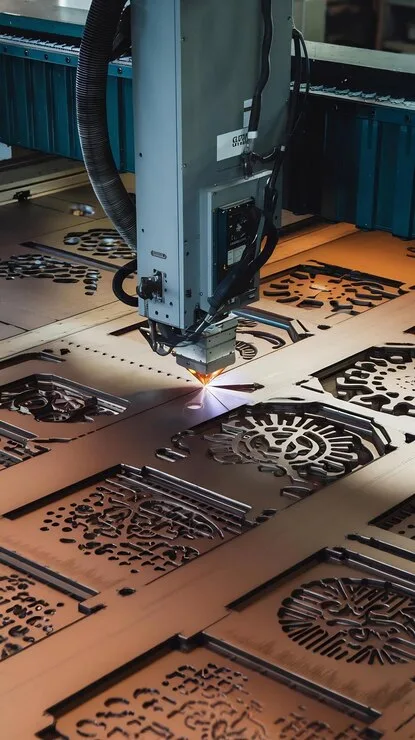
Most buyers we meet already know they want a laser. The real question is which source: a fiber laser or a CO₂ laser. The answer is decided almost entirely by what you cut, how thick it is and how many hours a day the machine will run.
The short answer
If you cut metal — mild steel, stainless, aluminium, brass, copper or galvanised sheet — buy a fiber laser. If you cut non-metals such as acrylic, wood, MDF, leather or textiles, a CO₂ laser is the right tool.
How the two sources differ
A fiber laser generates its beam inside a doped optical fibre and delivers it to the cutting head through a flexible cable. Its wavelength (around 1.07 µm) is absorbed very efficiently by metals. A CO₂ laser generates a 10.6 µm beam in a gas-filled tube and steers it to the head with mirrors. That longer wavelength is absorbed well by organic materials but reflects strongly off metals like copper and brass.
- Efficiency: fiber sources convert roughly 30–40% of electrical power into light; CO₂ sources manage around 10%.
- Maintenance: fiber has no mirrors, bellows or laser gas to replace. CO₂ beam paths need regular alignment and cleaning.
- Reflective metals: fiber cuts brass and copper reliably; CO₂ struggles and risks back-reflection damage.
Thickness and speed
On thin sheet (up to about 6 mm) a fiber laser is typically two to four times faster than a CO₂ laser of similar power. At higher powers — 12 kW to 60 kW platforms such as the GH, GV and Bevel GFA series — fiber now cuts thick plate that was once the preserve of plasma, with far better accuracy.
| Metric | Fiber | CO₂ |
|---|---|---|
| 3 mm mild steel | 12.0 m/min | 3.2 m/min |
| 10 mm acrylic | Not capable | 1.1 m/min, polished edge |
| Copper & brass | Yes | Unreliable |
| Power draw (6 kW) | ~20 kW | ~48 kW |
| Source life | 100,000 hrs | ~2,000 hrs (tube) |
| Annual maintenance | ₹40,000–60,000 | ₹1.4–1.8 lakh |
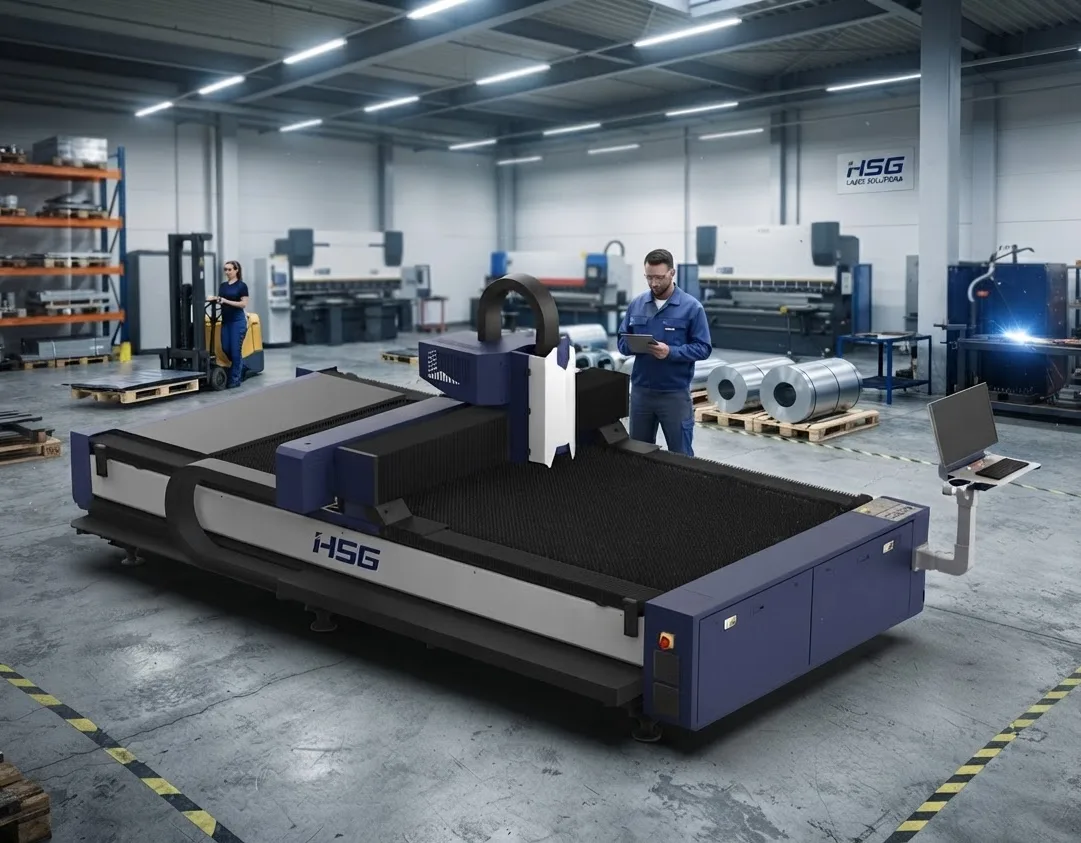
Running cost, side by side
Purchase price is where most comparisons stop, and it is the least useful number. Over a five-year horizon on two shifts, the gap in electricity, consumables and downtime routinely exceeds the difference in capital cost.
Typical for the same cutting output on two-shift operation.
No laser gas, mirrors or beam alignment on a fiber platform.
Typical throughput gain that changes what you can quote for.
When CO₂ still makes sense
CO₂ remains the better choice for acrylic signage (where a flame-polished edge matters), wood, paper, fabric and leather. If a large share of your work is non-metal, ask our applications team how a CO₂ platform fits alongside your fiber laser.
How to decide
- List your top five materials and their thickness range by volume.
- Estimate daily running hours — the more hours, the stronger the case for fiber.
- Send us sample drawings: our applications team can cut your parts before you commit.
Key takeaways
- Fiber for metal under 20 mm — faster, cheaper to run, far less maintenance.
- CO₂ for acrylic, wood, textiles and anything needing a flame-polished edge.
- Compare five-year running cost, not quoted price. The gap is usually decisive.
- Trial your own material before signing. Any serious supplier will agree to it.
Bring us your five most common parts. We will cut them on both sources and show you the edge, the cycle time and the cost per part — then the decision makes itself.
Applications team, Laser Technologies
Frequently asked questions
- Can a fiber laser cut acrylic or wood?
- Not well. The 1 µm fiber wavelength passes through clear acrylic and chars wood. Use a CO₂ laser for non-metals.
- Is a fiber laser cheaper to run than a CO₂ laser?
- Yes. Fiber sources are roughly three times more electrically efficient and need no laser gas or mirror replacement, so running cost per part is typically less than half.
- What laser power do I need for 10 mm mild steel?
- A 3–6 kW fiber laser cuts 10 mm mild steel comfortably; higher power mainly increases speed and edge quality with nitrogen or air assist.
Tags: Cutting, Guide, Insights